
How to Read a Pay Stub: Every Line Explained
A plain-English walk through every section of a US pay stub: earnings, taxes, deductions, year-to-date totals and the abbreviations nobody explains.

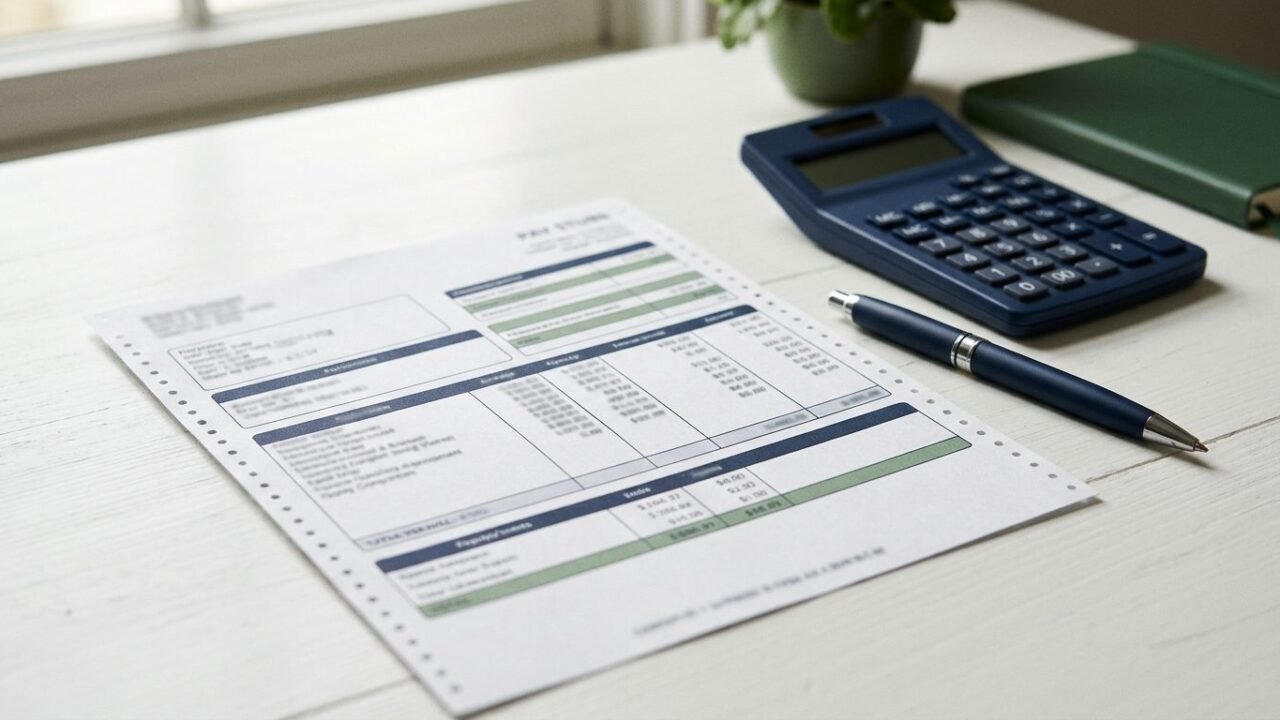
Your pay stub (also called a pay statement or earnings statement) shows how your gross pay turns into the amount that lands in your bank account. Layouts vary by employer and payroll company, but every US pay stub contains the same building blocks.
Here is what each section means, in the order you usually see it.
1. Personal and pay period information
The top of the stub identifies the paycheck:
- Employee name, ID and address. Check these are correct; errors can cause tax form problems later.
- Pay period. The dates you worked for this check, for example Nov 1 to Nov 15.
- Pay date. The day the money is paid. This is the date that counts for tax purposes.
- Filing status and allowances or W-4 info. Some stubs show the filing status from your W-4. If it looks wrong, your withholding may be off.
2. Earnings (gross pay)
This section lists everything you earned before anything is taken out.
| Line | What it means |
|---|---|
| Regular | Standard hours times your hourly rate, or your salary for the period |
| OT (overtime) | Hours over 40 in a workweek for non-exempt workers, usually paid at 1.5 times your rate |
| Holiday / PTO / Vacation | Paid time off used this period |
| Bonus / Commission | Extra pay, often withheld at a flat federal rate |
| Tips | Reported tips, which are taxable wages |
The total of this section is your gross pay. Most stubs show it twice: for this period (Current) and for the year so far (YTD).
3. Taxes
These are amounts your employer must withhold by law and send to the government on your behalf.
- Federal income tax (FIT, Fed W/H, FITW). Based on your pay and your Form W-4. It is a prepayment toward the income tax you owe for the year.
- Social Security (OASDI, SS, FICA-SS). 6.2% of your wages, up to a yearly cap of $184,500 for 2026.
- Medicare (MED, FICA-MED). 1.45% of all wages, with no cap. An extra 0.9% applies once your wages pass $200,000 in a year.
- State income tax (SIT, SWT). Depends on your state. Some states, such as Texas, Florida and Washington, have no state income tax on wages.
- Local tax. Some cities and counties tax wages too.
- State disability or family leave (SDI, PFL, FLI). Required in some states, such as California, New York and New Jersey.
Social Security and Medicare together are called FICA, 7.65% of most paychecks. Your employer pays a matching 7.65% that does not appear as a deduction on your stub.
4. Pre-tax deductions
These come out before income tax is calculated, which lowers your taxable wages.
- 401(k) or 403(b) traditional retirement contributions. These reduce income tax but not FICA.
- Health, dental and vision insurance premiums through a cafeteria plan (often reduce both income tax and FICA).
- HSA or FSA contributions.
- Commuter benefits for transit or parking.
5. Post-tax deductions
These come out after taxes are calculated:
- Roth 401(k) contributions
- Life or disability insurance you buy through work
- Union dues
- Wage garnishments, such as child support or court-ordered payments
- Charitable donations through payroll
6. Net pay
Net pay is what you actually receive: gross pay minus taxes minus all deductions. If you use direct deposit, the stub shows which account or accounts received it.
The basic formula is:
Net pay = Gross pay − Pre-tax deductions − Taxes − Post-tax deductions
7. Year-to-date (YTD) totals
The YTD column adds up every paycheck since January 1. It is useful for three things:
- Checking whether you have hit the Social Security wage cap.
- Estimating whether your withholding will cover your tax bill.
- Comparing against your W-2 in January. Your final YTD figures should match it closely.
8. Time off balances
Many stubs show accrued vacation, sick time or PTO, how much you used this period and what is left.
Common pay stub abbreviations
| Abbreviation | Meaning |
|---|---|
| FIT / FITW / Fed W/H | Federal income tax withheld |
| OASDI / SS | Social Security tax |
| MED / MEDI | Medicare tax |
| SIT / SWT | State income tax |
| SDI | State disability insurance |
| YTD | Year to date |
| OT | Overtime |
| PTO | Paid time off |
| Pre-tax / Sec 125 | Deductions taken before tax, often health insurance |
| Net | Take-home pay |
What to check on every pay stub
- Hours and rate match what you worked and agreed to.
- Overtime is paid at the right rate.
- Federal withholding is not zero unless you intended it (an exempt W-4).
- Benefit deductions match what you signed up for.
- YTD figures keep adding up correctly from the previous stub.
If something looks wrong, contact your payroll or HR department quickly. Errors are much easier to fix in the same year.
Pay stub questions
What does YTD mean on a pay stub?
YTD means year to date: the total of each item from January 1 through the current pay date.
What is OASDI on my paycheck?
OASDI stands for Old-Age, Survivors and Disability Insurance, which is Social Security tax. It is 6.2% of wages up to $184,500 in 2026.
Why is federal income tax not taken out of my paycheck?
Usually because your pay is low enough that no withholding is due for that period, or because your W-4 claims exemption or large credits. Check your W-4 with your employer.
Is gross pay before or after taxes?
Gross pay is before any taxes or deductions. Net pay is what is left after them.